
Currency Exchange, Travel Cards, and Airport Kiosks: Spending Abroad Without Getting Burned

Key Takeaways
- Airport currency kiosks typically charge the highest fees and least favorable exchange rates of any option.
- Travel-focused debit and credit cards with no foreign transaction fees can significantly reduce what you lose to conversion costs.
- Withdrawing local cash from in-network ATMs abroad usually beats prepaid travel cards and currency exchange booths.
- Carrying some local cash remains practical for small vendors, transit, and markets that don't accept cards.
- Comparing the mid-market rate against any quoted rate reveals the true cost of a currency conversion.
Our Verdict
No single method covers every situation abroad, but for most families the practical combination is a no-foreign-transaction-fee debit card for ATM withdrawals and a no-fee credit card for larger purchases. Airport kiosks and hotel exchange desks are the most expensive options and worth avoiding whenever possible. Planning your currency strategy before departure, as outlined in our family travel money checklist, saves real money.
| Best for | Recommended |
|---|---|
| Families who want simplicity and low fees on most purchases | No-foreign-transaction-fee credit card |
| Families needing local cash at the best available rate | Fee-free debit card at local ATMs |
| Families wanting a fixed, pre-loaded spending limit for kids or teens | Prepaid travel card |
| Emergency small-amount cash when no ATM is available | Bank or credit union exchange before departure |
Why the method matters more than the amount
When a family of four spends two weeks abroad, the gap between a well-chosen payment method and a careless one can easily add up to $100 or more in unnecessary fees. That money could cover a day of local meals or a museum admission. The core issue is that every time you convert dollars to a foreign currency, someone sets the rate and someone charges a fee. The question is who, and how much.
The mid-market rate (sometimes called the interbank rate) is the exchange rate banks use when trading with each other. It appears on Google or XE.com. Any provider quoting you a rate worse than that mid-market figure is building in a margin. That margin is their profit. Some margins are reasonable; others are steep. Understanding this single concept lets you evaluate any option you encounter. See how family travel spending breaks down for a broader look at where money leaks on trips.
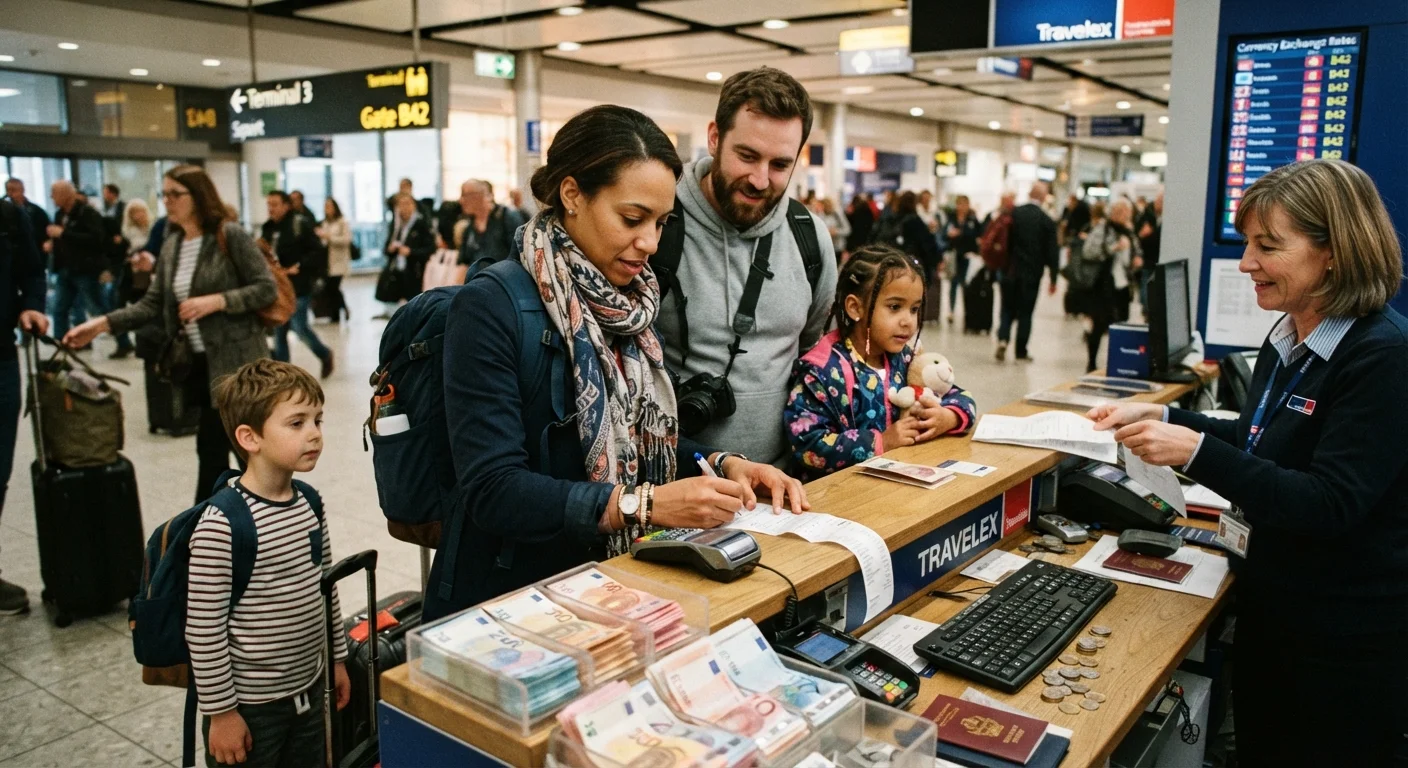
Airport kiosks and hotel exchange desks
These are convenient, and convenience is exactly what you pay for. Airport currency exchange operators and hotel desks routinely apply rates that are 8 to 15 percent worse than the mid-market rate, on top of a flat transaction fee. On a $500 exchange, that spread alone can cost $40 to $75.
The practical rule: exchange only what you need to get through the first few hours at the destination, such as a transit fare or a small meal. Get the rest through better channels once you are settled.
Dynamic Currency Conversion is a fee in disguise
When a card terminal or ATM asks if you want to pay in dollars instead of the local currency, always decline and choose the local currency. The conversion rate offered by the merchant or ATM operator is almost always worse than your card's network rate. This choice alone can save a family several dollars per transaction across a two-week trip.
Local ATMs abroad
Withdrawing cash from an ATM at your destination is typically the most cost-effective way to get local currency, provided your home bank account card charges no foreign ATM fees and your bank reimburses international ATM surcharges. Several checking accounts are designed with travelers in mind and waive these fees entirely. Before departure, confirm your card's foreign transaction fee, daily withdrawal limit, and whether your bank has international partner networks that reduce ATM charges.
One important trap: many international ATMs prompt you to pay in your home currency instead of the local one, a process called Dynamic Currency Conversion (DCC). Always choose to pay in the local currency. Accepting the ATM's conversion rate typically costs 3 to 7 percent more than your bank's rate. This applies at card terminals in stores and restaurants as well.
For a pre-departure checklist that includes notifying your bank and confirming card settings, see this family travel money checklist.
Travel credit and debit cards with no foreign transaction fees
A standard U.S. credit card charges a foreign transaction fee of around 3 percent on every international purchase. That 3 percent adds up across a family trip. Cards specifically designed for travel waive this fee entirely, meaning you get a rate very close to the mid-market rate on every swipe. Many also offer some travel protections, though coverage varies widely by issuer.
Debit cards from certain online banks and credit unions work similarly at ATMs: they charge no foreign transaction fee, pass through the network exchange rate, and refund ATM operator surcharges up to a monthly cap. For families, carrying one travel credit card for purchases and one fee-free debit card for cash withdrawals covers most situations. Planning a family trip abroad without overspending covers how card choices fit into the broader trip budget.
| Airport kiosk | Bank branch (pre-trip) | Local ATM abroad | Travel credit card | Prepaid travel card | |
|---|---|---|---|---|---|
| Exchange rate quality | Poor (8-15% margin) | Fair (2-5% margin) | Good (near mid-market) | Good (near mid-market) | Fair (varies by card) |
| Transaction fees | High flat fee | Low or none | ATM surcharge possible | None (fee-free cards) | Reload and ATM fees vary |
| Convenience | Very high at airports | Requires advance planning | Moderate (find ATM) | Very high | High once loaded |
| Cash availability | Immediate | Before departure | On arrival | No cash directly | Yes, via ATM withdrawal |
| Good for families | Emergency only | Small amounts, niche currencies | Primary cash source | Primary card purchases | Teen spending control |
Prepaid travel cards
Prepaid travel cards let you load a set amount in one or more foreign currencies before you leave. The appeal is budget control: a parent can load a teen's card with a fixed daily allowance, for example. The drawback is that the exchange rate applied when you load the card often includes a margin, and some cards charge reload fees, inactivity fees, or fees for withdrawing cash at ATMs.
These cards work best as a secondary tool for budget control, not as a primary payment method. Read the fee schedule before loading any amount. Hidden costs in travel products are a recurring theme that this guide on hidden vacation costs covers in detail.
Carrying some local cash
Cards are refused or impractical at street markets, small local restaurants, rural transit stops, and many family-friendly entry-fee attractions in less tourism-heavy areas. Carrying a modest amount of local cash is not just convenient; it is sometimes the only option. The goal is to obtain that cash at the lowest cost, which in most cases means an ATM withdrawal after arrival rather than an airport exchange.
Ordering foreign currency from your U.S. bank branch before departure is a middle-ground option. Rates are better than airport kiosks, though usually not as good as ATM withdrawals abroad. It makes sense for currencies that are harder to obtain at local ATMs, or when you want cash in hand before landing. Costs families overlook when booking include currency conversion losses alongside other common surprises.
This article is for general informational purposes only and is not financial advice. Currency fees, card terms, and ATM policies vary by institution and change over time. Verify current terms directly with your card issuer or bank before traveling.