

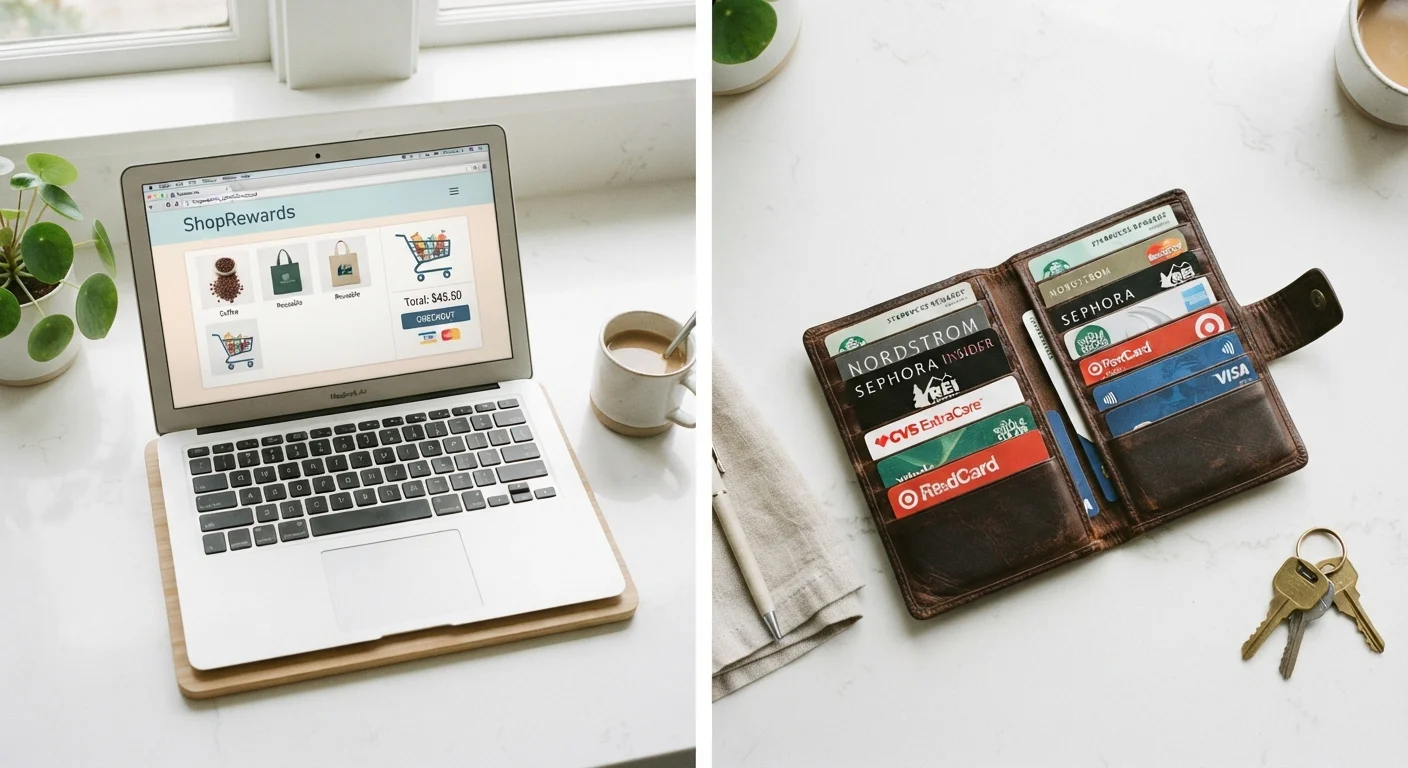
Key Takeaways
- Shopping portals pay a percentage of a purchase back as cash, usable anywhere once redeemed.
- Loyalty cards accumulate points or stamps redeemable only within a specific retailer's ecosystem.
- Portals work online; most loyalty programs still center on in-store or that retailer's own app.
- Both can run simultaneously on some purchases, though restrictions vary by retailer.
- Portals require remembering to activate before checkout; loyalty cards work passively at the register.
- Neither system generates savings unless spending would have happened anyway.
Option A
Online shopping portals
The flexible, browser-based cashback layer.
Best for: Families who shop across many online retailers and want cash returned as real money.
Option B
In-store loyalty cards
The dedicated points system tied to one retailer.
Best for: Families who shop at the same stores repeatedly and want discounts or perks at checkout.
If your family shops across several different online stores each month
Online shopping portals
Portals apply to purchases at dozens or hundreds of retailers, so rewards accumulate without being locked to one brand.
If your family buys groceries or gas from the same chain every week
In-store loyalty cards
Frequent, concentrated spending at one retailer accelerates point accumulation and unlocks member-only discounts faster.
If you want rewards you can spend anywhere, not just at one store
Online shopping portals
Most portals pay out as transferable cash or gift cards, giving you full flexibility on how rewards are used.
If you prefer a frictionless, automatic experience at the register
In-store loyalty cards
Swiping a card or scanning an app at checkout requires no advance setup on each trip, unlike portals that need pre-activation.
How each system earns rewards
Online shopping portals sit between you and a retailer's website. You log into the portal, click through to a store, and the portal records the transaction. A percentage of your purchase total comes back to your portal account, typically as cash or points convertible to cash. The portal earns a referral fee from the retailer and passes part of that fee to you. No portal membership changes what you pay at checkout; the reward comes after the fact.
In-store loyalty cards work on a different principle. The retailer assigns points, stamps, or tier credits for each dollar spent. Those credits stay inside the retailer's system and can only be redeemed for that retailer's products, services, or discounts. Some programs add member-only pricing at the shelf, which reduces what you pay immediately rather than returning money later.
For a plain-language overview of how these reward types fit into a broader picture, see Rewards Programs Demystified.
| Criterion | Online shopping portals | In-store loyalty cards |
|---|---|---|
| Where it works | Online, across many retailers | In-store and retailer's own app |
| Reward type | Cash or transferable points | Proprietary points or stamps |
| Redemption flexibility | Spend anywhere once redeemed | Restricted to issuing retailer |
| Activation required | Yes, before each session | No, passive at checkout |
| Expiration risk | Varies by portal policy | Often tied to account activity |
| Member-only pricing | Rarely included | Common at grocery and drug chains |
| Category exclusions | Gift cards, travel, some sale items | Pharmacy, alcohol, clearance |
Payout structure and flexibility
Portal cashback usually pays out after a waiting period, often 30 to 90 days, to account for returns. Once the balance clears, most portals let you transfer it to a bank account, PayPal, or a gift card. That flexibility means portal earnings can offset any household expense, not just future purchases at one store.
Loyalty points carry more restrictions. Expiration policies vary widely; some programs zero out balances after 6 to 12 months of inactivity, while others have no expiration at all. Redemption is typically limited to the issuing retailer, and the implied value per point can shift when a retailer adjusts its rewards chart. Families who spread shopping across many stores may find points accumulate too slowly at any single program to reach meaningful redemption thresholds.
To understand how these mechanics compare to credit card rewards, see how cashback apps, credit cards, and loyalty programs differ.
30-90 days
Typical portal cashback waiting period
Most portals hold earnings during a return window before releasing funds to your account.
6-12 months
Inactivity window before points expire
Many in-store loyalty programs zero out balances after a period of no account activity, though policies vary.
1-10%
Typical portal cashback rate range
Rates vary by retailer and category; promotional rates for new members or seasonal events can exceed this range.
Practical friction and failure points
The biggest operational difference is activation. Portals require you to start every session from inside the portal or with a browser extension active. Forgetting this step means earning nothing, even on a large purchase. Loyalty cards, by contrast, are passive once enrolled: scan the card or app at the register and points post automatically.
Portals also have retailer exclusions. Certain product categories, including travel, gift cards, and some sale items, are often ineligible. These exclusions are usually disclosed in fine print and can catch families off guard. Loyalty programs have their own exclusions, typically alcohol, tobacco, pharmacy items, and clearance merchandise, but these tend to be consistent and predictable.
Both systems carry the same foundational risk: spending more than planned to chase rewards erases any real benefit. Common cashback misconceptions cover this in more detail.
When running both makes sense
Some retailers allow portal cashback and loyalty points to accumulate on the same transaction. A grocery chain with an online ordering option, for example, may accept a portal click-through while still crediting your loyalty account. However, retailer policies on this vary and can change, so it is worth checking program terms before assuming both will apply.
For families interested in layering these systems intentionally, stacking rewards on the same purchase explains where the approach works and where programs specifically prohibit it.
The spending categories where each type of reward tends to pay off most are also worth knowing before committing to either system. Everyday spending categories where cashback adds up fastest maps out where reward rates are typically highest.